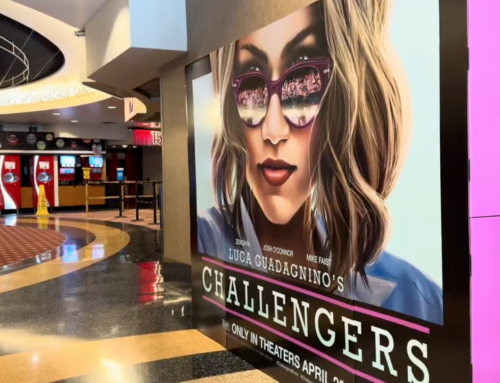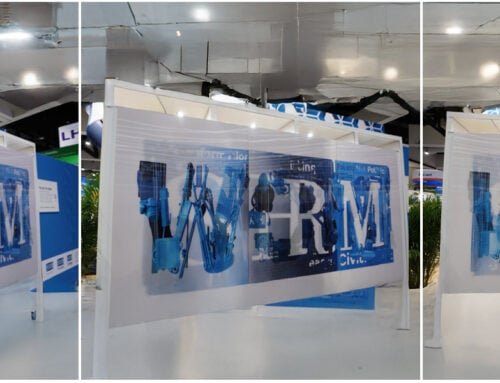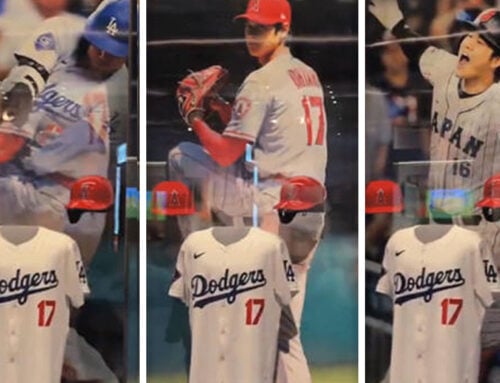


Everyone is impressed when they see a 3D lenticular print, partially because it almost seems like something magical. So people are always asking “how does this work?”. The answer is that lenticular lenses are creating the effect and this article will explain how.
You likely recognize lenticular as the technology behind those trading cards Kelloggs gave away in the 1970s, Hollywood DVD covers from the 90s, or modern movie posters, high-end direct mail pieces, and even recent retail displays for brands like Nike and Coca-Cola. All of these use lenticular lenses but how do they create those eye-catching 3D effects?
What Are Lenticular Lenses?
The word “lenticular” comes from the Latin word for lentil, which describes the shape of these tiny lenses. A lenticular lens sheet is plastic that has hundreds of these small, elongated lenses running parallel across the surface of the material. Think of it like a plastic sheet with tiny magnifying glasses lined up next to each other, all running in the same direction. These ridges are called lenticules, and they’re the key to the whole process. Each line acts as a tiny lens that shows you different parts of the printed image depending on your viewing angle. It’s this simple but clever arrangement that creates all the magic.
Although there are many names for the different effects that lenticular can display, they really break down into two categories: 3D and animation. Each is created with a combination of digital interlacing (splicing multiple images together into one file), and viewing that interlaced image through a lenticular lens sheet.
How Do Lenticular Lenses Work?
Animation is anything that changes as your view changes, whether that’s a 2-frame flip, a morph, a zoom or a full animation. The animation effect is achieved when the interlaced image is printed onto a lenticular lens which serves to block all but one frame from your view. As you move the piece (or you move your head), the lenses block the original frame and show you the one next to it in the interlaced file. So changing your angle changes the view.
On the other hand, 3D lenticular does not change when the viewer’s angle changes. It always shows the same image which appears in full glorious 3D from any angle. So how does this happen? First, it’s important to understand that we humans perceive depth based on the difference between what our two eyes see. If you keep one eye closed, you will lose all depth perception. This explains why photos typically can’t display depth—the camera has only one “eye”. When you wear those 3D glasses that show depth, one eye is looking through a blue filter and one is looking through a red filter. The image is printed in red and then has a slightly offset copy of the same image printed in blue. The same thing goes for 3D movies, the film is printed with blue and red offset copies and the glasses decode it. So to see something in 3D, we need our two eyes to see the same image from slightly different angles. This allows our brains to do the math and perceive what is closer and what is slightly farther from us.
With this in mind, we can now think about the lenticular lens sheet and how it creates a 3D effect. Instead of the lens showing us completely different images (as it does with animated lenticular), the lens serves to show one image to the left eye, while simultaneously showing the same image, slightly offset, to the other eye. Just like with the 3D glasses, the difference between what the left eye sees and what the right eye sees creates the illusion of depth. But with lenticular lenses, no special glasses are needed. The lenses do the work of separating the two images, and the print seems to magically appear in 3D.
Creating 3D Effects with Lenticular Printing
The process starts with your source artwork. We take those source files and run them through specialized software that interlaces them together. The software slices each frame into thin vertical strips and weaves them together in the precise pattern needed to work with the lens material. Then we print that interlaced file directly onto the back of the lenticular lens sheet using high-quality digital printing.
Any lenticular lens can be used for any lenticular effect. However, there are specialty lenses that excel for 3D images. While clients typically can’t see or feel any difference, minuscule changes to the lens can serve to enhance one effect vs another. We inventory multiple lenses and will always guide the project towards the best lens for the application.
Where 3D Lenticular Lenses Are Used Today
The applications for lenticular really are endless. As we point out right on our homepage, lenticular really serves three purposes: 1) grab attention 2) tell a story 3) create a buzz. In most cases, animated lenticular will do the best job with telling a story. 3D lenticular does not change so it conveys less information. But when it comes to grabbing attention and getting people talking, 3D can be hard to beat. It’s that magical quality that always makes people notice.
We produce lenticular prints for direct mail postcards that actually get saved instead of thrown away. Trade show displays that stop people in their tracks. Point-of-purchase signage that outperforms traditional print every time.
We have produced everything from high school yearbook covers, to postcards for large pharmaceutical companies, to trade show displays for T-Mobile and ever 120’ long murals for Gatorade. Our clients include hundreds of the world’s largest brands spanning nearly every imaginable industry. And more recently, artists have discovered lenticular as an entirely new art medium, producing pieces that sell for thousands of dollars. We recently produced a 12″ x 19″ lenticular art piece for a local artist that sold for $7,000!
Why Lenticular Printing Works
Whether displaying 3D depth or animation, lenticular works because it gets noticed and stands out in a way that traditional printing simply can’t match. And whether it’s used in a trade show display, a direct mail postcard, packaging or some entirely novel application, people consistently stop and pay attention when they see it.
Think about a direct mail piece. How many paper postcards get tossed in the trash without a second glance? Now imagine an animated postcard that moves when you tilt it, or a 3D image that seems to pop right off the page. Not only does it get noticed in the stack of mail, it gets kept. It gets shown to other people. It creates an impression that lasts.
In the current environment of screens, scrolling and nonstop vying for attention, lenticular will always stand out and do the job in a way that no screen can match. The prints are also surprisingly durable. We’ve seen lenticular pieces from the 1950s that still look great. When displayed indoors, they should last indefinitely.

Getting Started with Lenticular Printing
If you’re considering lenticular for your next project, the process is straightforward. We start by talking about your goals for the image and what you’re trying to communicate. Are you looking to grab attention? Explain a product? Tell a story? Create something collectible? Once we understand the objective, we can guide you on the best approach.
We can help you decide if 3D or animation is right for your project. From there, we will help guide you to get artwork set up correctly and we’ll produce a digital proof for approval. Once you approve the proof, we move into final production and shipping.
For more than 30 years, we’ve helped thousands of clients bring their ideas to life using lenticular printing. Every project is different, and honestly, that’s what makes this work interesting. Whether it’s a small bookmark or a 100-foot mural, and whether the project displays 3D or animation, lenticular printing is the backbone of endless successful marketing campaigns.
Lenticular printing has proven itself as a powerful marketing tool over and over again. The real question now is: how would you use it to achieve your marketing goals? How would you harness motion and depth to tell your story or cut through the clutter?
That’s where things get creative, and that’s exactly what we’re here to help you figure out.